



Quaternary International
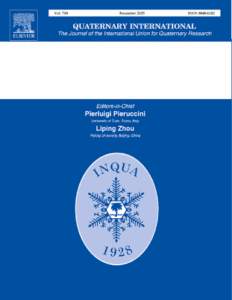 Quaternary International, the hybrid INQUA/Elsevier Journal, publishes peer-reviewed, high-quality research articles that reflect recent advances in all the disciplines of Quaternary science and appeal to the wide audience of the global Quaternary community. In addition to regular submissions, special issues organised by leading scientists to address major scientific questions in contemporary Quaternary research are welcomed. The first four issues of Quaternary International appeared in 1989. The journal currently publishes 36 volumes each year.
Editors-in-Chief
Pierluigi Pieruccini, Università degli Studi di Torino, Italy
Liping Zhou, Peking University, Beijing, China
Editors
We are pleased to welcome the new Associate Editors:
Yoshihiro Nishiaki, The University of Tokyo, Japan
Anne Marie Bacon, National Centre for Scientific Research, Paris, France
Julie Loisel, University of Nevada, Reno, United States of America
Guzel Danukalova, Federal Research Centre, Russian Academy of Sciences, Ufa, Russian Federation
Yaspal Sundriyal, Doon University, India
Eduardo Guimaraes Barboza-Pinzon, Universidade Federal do Rio Grande do Sul, Brasil
William Gosling, University of Amsterdam, The Netherlands
They join Evdokia Tema (University of Torino, Italy) who was part of the former Editorial Team.
The new Editorial Team will ensure the highest scientific quality of published research. As Editors-in-Chief, we look forward to working together and fostering an atmosphere of trust and friendship, essential for the success of our journal and the INQUA community.
Letter from the Editor-in-Chief
Dear Quaternary International community,
At the end of October 2025, Quaternary International underwent a renewal of the Associate Editorial Team. So, five of the former Associate Editors reached the end of the six-year term: Patrick Roberts (Max Planck Institute for Geoanthropology, Jena, Germany), Marian Berihuete Azorín (Autonomous University of Barcelona Pre-history Department, Barcelona, Spain), Hema Achyuthan (Anna University, Chennai, India), Qingzhen Hao (Institute of Geology and Geophysics, Chinese Academy of Sciences, Beijing, China) and Jan-Berend Stuut (Royal Netherlands Institute for Sea Research, Den Burg, Netherlands) are going to leave the Editorial team.
We met together in 2019 at INQUA Dublin, when Thijs van Kolfschoten was looking for a new Editorial Team and a new editorial policy for Quaternary International. At that time, the team also included Andrea Zerboni (Department of Geosciences, University of Milan, Italy), Alexander Francke (School of Physics, Chemistry and Earth Sciences, Adelaide University, Australia) and Jule Xiao (Institute of Geology and Geophysics, Chinese Academy of Sciences, Beijing, China); they had left much earlier their positions for various reasons, and I am still very grateful for their contributions to the Journal.
These have been six years during which the Editors have spent their time devoting a huge effort to managing the editorial workflow with great scientific and human competence, and above all, with genuine and spontaneous empathy in serving our INQUA community by ensuring the high scientific quality of the published research.
During these six years, we have also faced and shared ups and downs, but the invaluable work they did, has demonstrated the determination to overcome challenges and to face the changes and new solutions that have arisen along the trip.
I want to sincerely thank again each of you, Patrick, Hema, Marian, Qingzhen and Jan-Berend for your dedication, professionalism, and collaboration.
This was an outstanding team, and I feel honoured and pleased to be part of such a team. I hope that we will cross and meet again at future INQUA and scientific events, and I wish you all the best, of course for your profession but mainly for your life and the lives of your beloved ones.
Pierluigi Pieruccini
Editor in Chief
Quaternary International
News
The official Journal of the INQUA community, Quaternary International, continues its mission to serve as a platform for the publication of high-quality research in the field of Quaternary Science reflecting the scientific output arising from INQUA Commission activities, INQUA-funded projects, and Research conducted at Institutions worldwide.
With a recently renewed Editorial Board and a dedicated team of Associate Editors, the journal ensures a consistent and rigorous editorial process for the 36 volumes published each year, including the numerous Special Issues focused on specific topics.
In addition to traditional Research and Review Articles, the journal now welcomes Short Communications, aimed at reporting preliminary results, recent field or laboratory discoveries, and early outputs from ongoing scientific projects—including innovative methodologies and analytical tools.
The entire INQUA community is warmly invited to submit manuscripts and to propose Special Issues that address key scientific questions in contemporary Quaternary research. Proposals linked to international research initiatives, workshops, symposia, and other special events are especially welcome. We particularly encourage leaders of INQUA-funded projects and INQUA Fellowship holders to propose Special Issues based on their research topics
Editor’s choice
The editor’s choice is focused on the Special Issues that have recently been published on QI.
Our most recent Special Issues, now featured on the journal’s homepage, showcase cutting-edge research across all fields of Quaternary science. Dive into the latest scientific advances, explore diverse topics from around the globe, and get inspired by contributions from leading experts.
Discover the Latest Special Issues from Quaternary International by visiting our website and exploring the full Special Issues Collection.
Millennial Paleo-landscape Reconstructions of Coastal Areas: From Field Data to Modelling Approaches Edited by: Gaia Mattei; Claudia Caporizzo; Pietro P.C. Aucelli; Ana Novak
Late Holocene Human Driven Dynamics and Landscape Evolution on the Central Mediterranean Coastal Areas: Geoarchaeological, Biological and Archaeological Perspectives (ERC nEU-Med Project) Edited by: Mauro Paolo Buonincontri; Giovanna Bianchi
Paleoclimate records from the Southern Hemisphere Edited by: Julieta Massaferro; Christoph Mayr; Nicolas Waldman
The 7th Conference on Environmental Archaeology in China: Research progress during 2017-2023 Edited by: Zhen Qin; Kaifeng Li
Late Quaternary desertification, landscape changes, paleoclimate, and human adaptation in Eurasian drylands Edited by: Rayees Shah; Hema Achyuthan; Xiao Fu
Quaternary Climate Reconstruction Using Multiproxy Approach and Mathematical Techniques Edited by: Upasana S. Banerji; Chandra Prakash Dubey; Laxmi Pandey; Md. Firoze Quamar; Kumar Batuk Joshi
Countryside and woodlands buried by the 79 AD Vesuvius eruption: An archaeobotanical attempt at synthesis Edited by: Alessia D’Auria; Gaetano Di Pasquale; Anna Maria Mercuri
Proceedings of the 30th Pacific Climate Workshop (PACLIM) Edited by: Scott W. Starratt; Michael McGlue
Read on publications


News News
View moreLatest developments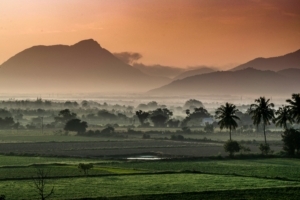 INQUA Travel Grants for the XXII INQUA Congress 2027
Travel grants now open!
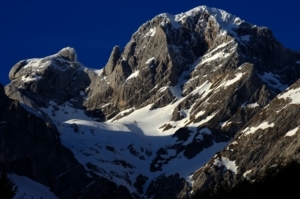 8th Regional Meeting on Quaternary Geology, Slovenia – Call for abstracts
The event will take place from 4–6 November 2026 in Čatež ob Savi, East Slovenia.
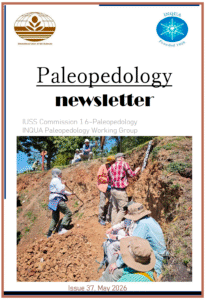 Paleopedology newsletter Issue 37
Paleopedology newsletter Issue 37 is now published!
 Podcast INQUA India 2027
Quaternary is the age when modern recognisable humans started inhabiting this planet. All over the world scientists are engaged in studying various aspects of human evolution. Once every 4 years scientists from all across the…
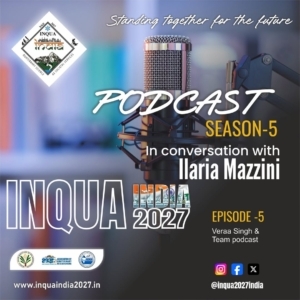 Podcast INQUA India 2027
Quaternary is the age when modern recognisable humans started inhabiting this planet. All over the world scientists are engaged in studying various aspects of human evolution. Once every 4 years scientists from all across the…
 QI Special Issue: Mapping Ancient Africa
The QI Special Issue Mapping ancient Africa: Climate, vegetation & humans is the result of an INQUA-funded project