Project 2454 sa: Quaternary Sediments, Landscapes, and Early Settlement History in Western Estonia (PWGM 2024)
This project brings together Quaternary researchers and students for field symposium to explore the Quaternary sediments, landscapes, and early settlement history in western Estonia.
Abstract
The INQUA Peribaltic Working Group is a regional group of researchers active in various fields of Quaternary science (http://inqua-peribaltic.ut.ee/inqua-peribaltic-working-group). It was founded in the 1990s, and since then, it has provided a cooperation platform for approximately 100-120 Quaternary researchers and students. In 2024, the Peribaltic WG Field Symposium “Quaternary Sediments, Landscapes and Early Settlement History in Western Estonia” took place in western Estonia in August 26-30, 2024. More than 60 researchers and students have registered, and more than 40 oral and poster presentations were presented during the event.
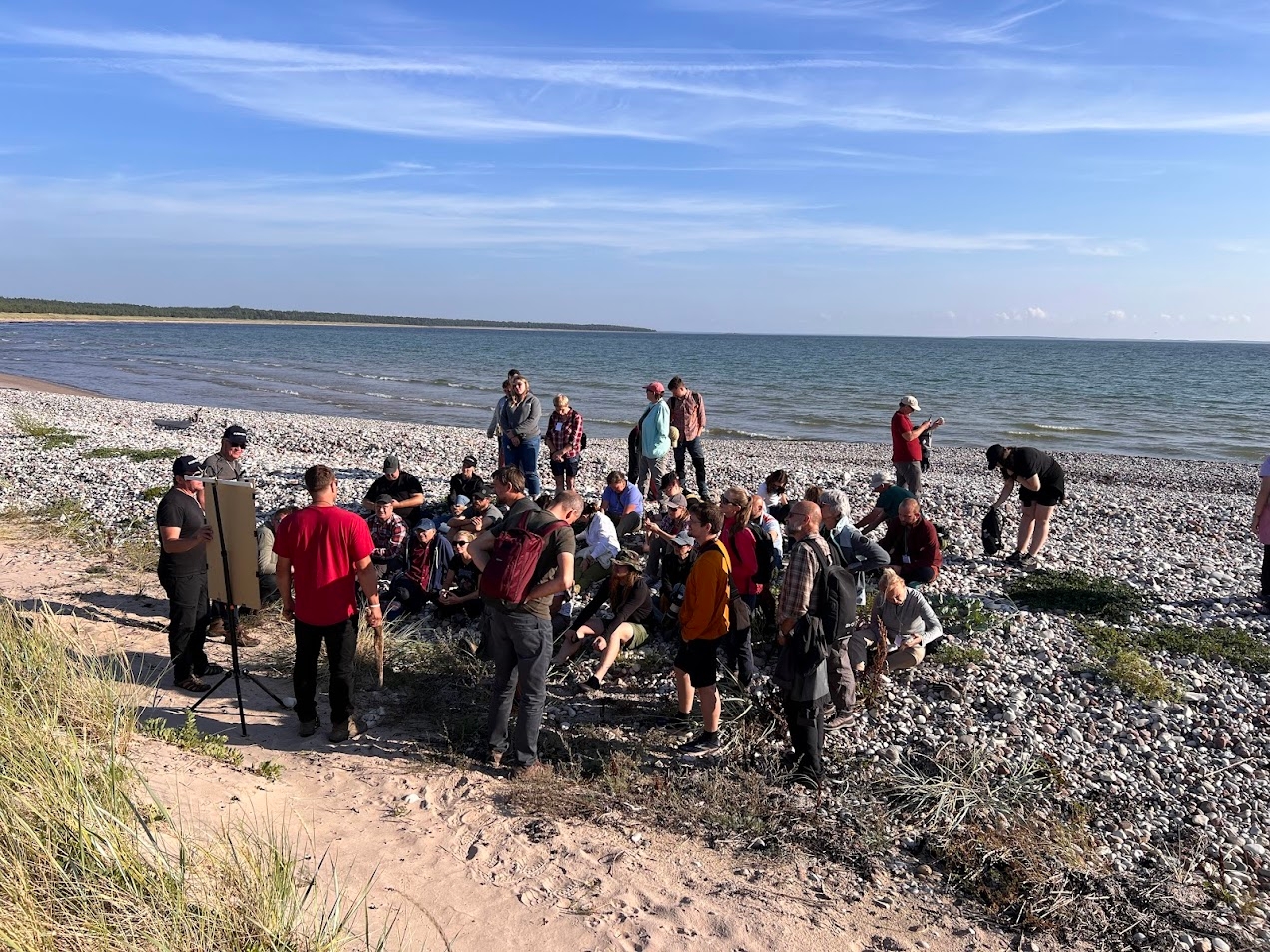
During the four-day field trip in western Estonia, the various topics with site visiting has been discussed, including environmental geology (landslides in proglacial clays, wetland restoration, flooding of coastal areas), relative sea-level changes and storminess scenarios, shallow sea-bed mapping, coastal processes and the health of beaches, and geoarchaeology opening the links between landscape and early settlement pattern.
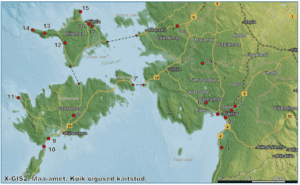
Figure. An overview map showing the field sites visited during the field symposium. Stop 1: Tolkuse palaeolagoon and Rannametsa dunes; Stop 2: Ancient channel of River Pärnu; Stop 3: Pulli, earliest archaeological site in Estonia; Stop 4: Sindi-Lodja archaeological site; Stop 5: Sandy beach in Pärnu; Stop 6: Landslide in 2022 on the right bank of the Audru River; Stop 7: Mapping of the shallow sea floor and geology of the Suur Strait and the inner part of the Väinameri in the West Estonian Archipelago; Stop 8: Kaali impact crater(s) and the timing of the event; Stop 9: Järve beach; Stop 10: Salme Viking Age boat burials; Stop 11: Harilaid Peninsula; Stop 12: 6.5 ka palaeostorminess record from Tihu coastal spit system; Stop 13: The Kõpu peninsula and the oldest lighthouse in Estonia; Stop 14: Ristna spit and mapping of the offshore glacial landforms; Stop 15: Lehtma harbour; Stop 16: Erratic boulder field at the slope of Kärdla impact structure rim; Stop 17: The Kärdla impact structure; Stop 18. Palivere ice-marginal formations and distribution of eskers in Estonia; Stop 19. Varved clays and varve chronology for western Estonia.
Objectives:
- To improve level of scientific research and communication between researchers and students working on glacial and post-glacial history of the Peribaltic region during the Quaternary;
- To support the professional development of next generation of Quaternary scientists by providing networking opportunities and the practical education (field site visiting) in different Quaternary geological topics.
Project leaders:
- Alar Rosentau, Institute of Ecology and Earth Sciences, University of Tartu, Estonia
- Sten Suuroja, Estonian Geological Survey, Estonia
- Tiit Hang, Institute of Ecology and Earth Sciences, University of Tartu, Estonia

Latest developments
View moreLatest developments QEH Special issue: Call for papers
Anthropisation of riverscapes
 Royal Society meeting issue
Philosophical Transactions B under the ‘Subscribe to Open’ 2026 initiative
 Quaternary Science in Latin America: Building the Future from the Global South!
The First Latin American INQUA Meeting – 2026 is coming to Puerto Madryn, Patagonia, Argentina, on 11–12 November 2026! 🇦🇷
 QP Issue 40 Now published
The new issue of Quaternary Perspectives was published!
 Geo-Research Scholars Meet 2026 India
The Geo-Research Scholars Meet, will be hosted by the Wadia Institute of Himalayan Geology, India